

Café · Philadelphia · ⭐ 9.3/10 · 2078 reviews · updated: 2026-08-10 17:37:57
Address: 1335 Frankford Ave, Philadelphia, PA 19125, United States
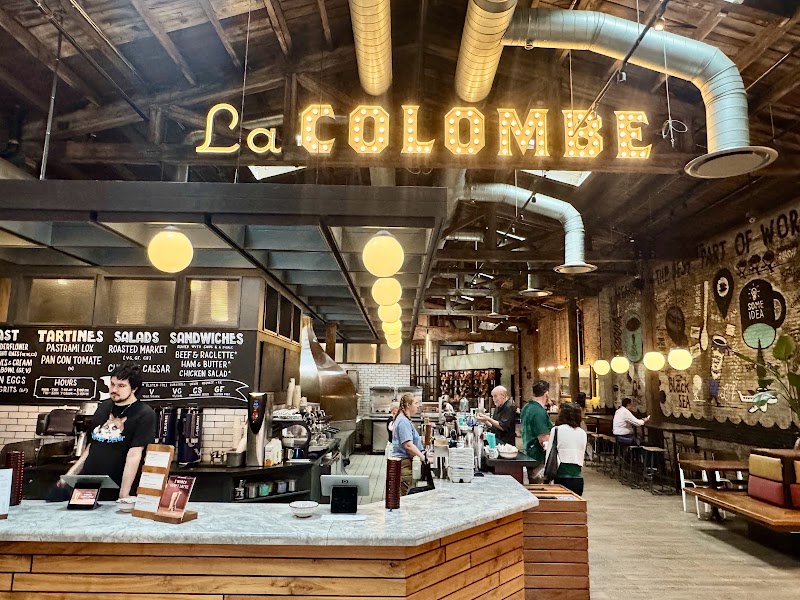
Most cafés that put a roaster behind glass do it as decoration. In Fishtown the roasting came first and the café was built around it — together with a bakery, an open kitchen and a working rum still. La Colombe Coffee Workshop is the flagship of a company that began in Philadelphia in 1994 and now ships coffee across the country, and it is the one address where the whole operation is happening in front of you in a single enormous room.
Highlights
- A warehouse of roughly eleven thousand square feet turned into café, roastery, bakery and company headquarters at once — the scale is the first thing that hits you through the door.
- No Wi-Fi, and that is a decision — power outlets exist, the internet does not, and that single choice quietly sorts out who ends up spending the afternoon here.
- A rum distillery behind glass at the back of the room, where a coffee-infused house rum is made on a custom-built still.
- The Silverton method, an in-house brewing style that sits between immersion and filter, closer to a Clever dripper than to a pour-over cone, and not something you will be offered at most counters in the city.
- Bread baked on the premises in an open kitchen behind the counter, rather than delivered in crates before opening.
- Sparkling water on a free-flowing tap — a small signal that the room expects you to sit rather than sprint.
What’s in the cup
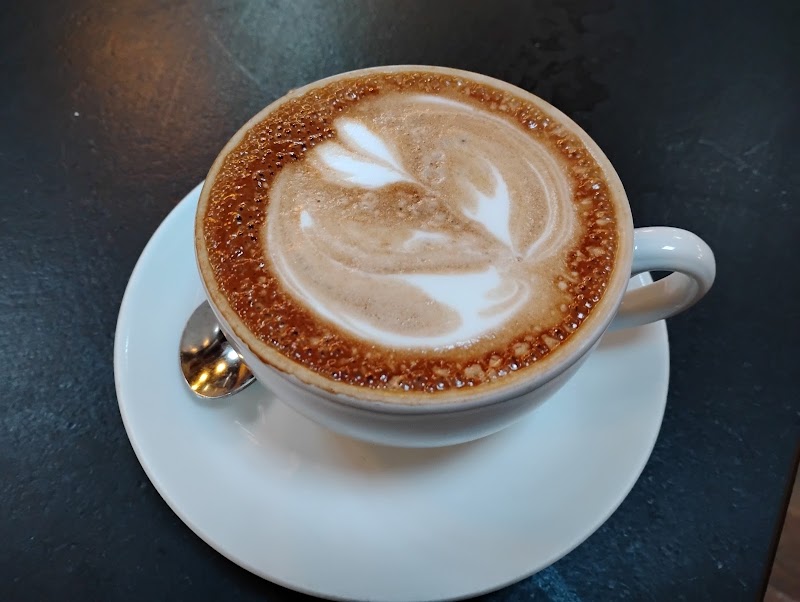
La Colombe roasts, and has roasted since the beginning, which puts it in a different category from the many good cafés that buy from someone else. The house identity was built on classic espresso rather than on light Nordic-style filter: a roast profile aimed at body, sweetness and a cup that holds up under milk. That is the historical center of gravity here, and it is why the brand became the default espresso in a long list of American restaurants and hotels long before most people had heard of third-wave coffee.
The Workshop is where the range is widest. Espresso and milk drinks are the volume business, bulk-brewed coffee handles the morning rush, and hand-poured filter is there for anyone who wants the origin to speak on its own. The house Silverton method is the interesting outlier — a hybrid that steeps the grounds like an immersion brew and then drains them through a filter, producing a heavier, rounder cup than a standard pour-over without the muddiness of a French press. It is a small piece of coffee engineering that the company invented for itself, and the flagship is the natural place to try it.
The other thing worth knowing is that this company’s biggest single contribution to American coffee culture was arguably not brewed at all: the canned draft latte, textured with nitrogen and sold cold, came out of this operation and was widely copied afterward. You can taste the same idea at the counter, and it is a fair reminder that the roastery has always been as interested in engineering as in agriculture.
Who’s behind it
The company was founded in 1994 by Todd Carmichael and Jean-Philippe Iberti, who met during Seattle’s coffee boom in the late 1980s and moved the idea east. The name comes from La Colombe d’Or in the south of France, and the split of temperaments — one founder relentlessly entrepreneurial and famous for traveling to growing regions himself, the other bringing a European café sensibility — is written into the brand. The first Philadelphia café had a micro roaster in the back; the Fishtown Workshop is the same idea grown to industrial size.
In 2023 the company was bought by Chobani in a deal reported at around nine hundred million dollars, which changed the ownership but not the address: the roasting, the offices and the flagship counter all stayed in Fishtown. That is worth mentioning honestly, because a visitor who expects a small independent café will find something else — this is a national brand’s home base, with the confidence and the corporate polish that implies.
Who it’s for
The absence of Wi-Fi is the single most useful fact for planning a visit, and it cuts both ways. If your plan was a long working session with a laptop and a browser full of tabs, this is the wrong room — you would be tethering off your phone, and the space is not built for that anyway. If your plan is offline work, a book, a notebook, an interview, or a couple of hours of thinking with nobody messaging you, it is close to ideal: outlets are available, nobody hovers over your table, and the noise is the diffuse hum of a big room rather than the pressure of a small one.
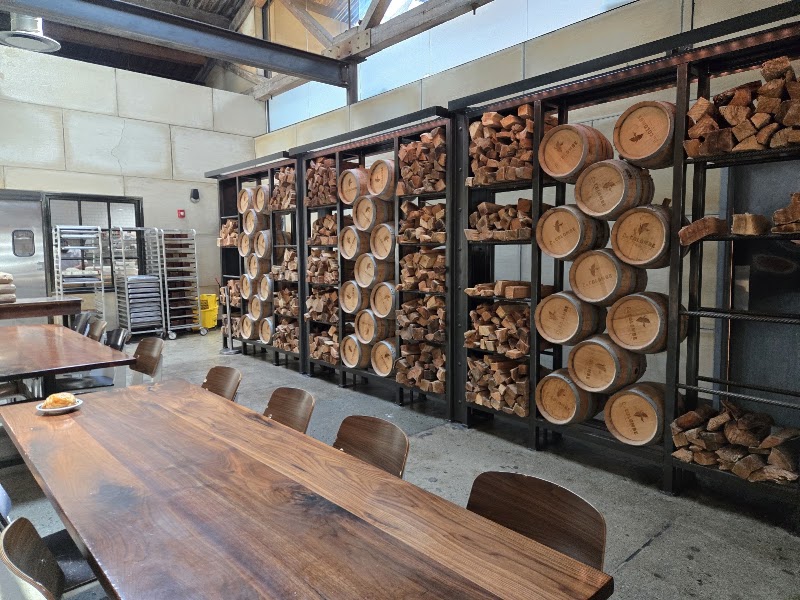
For a conversation it works very well. The ceilings are high enough that sound disperses instead of bouncing between two people at the next table, and the mix of seating means a pair, a group of six and a person alone can all find something that fits. It is also one of the few cafés in the city that genuinely works for a group of visiting friends, because a communal table for eight is not an afterthought here.
For coffee to carry away it is straightforward and quick, and there is usually bread and something baked at the counter to take with it. And for a certain kind of visitor — someone who wants to understand what Philadelphia contributed to American coffee — the Workshop functions as a small unofficial museum you are allowed to sit inside.
The space
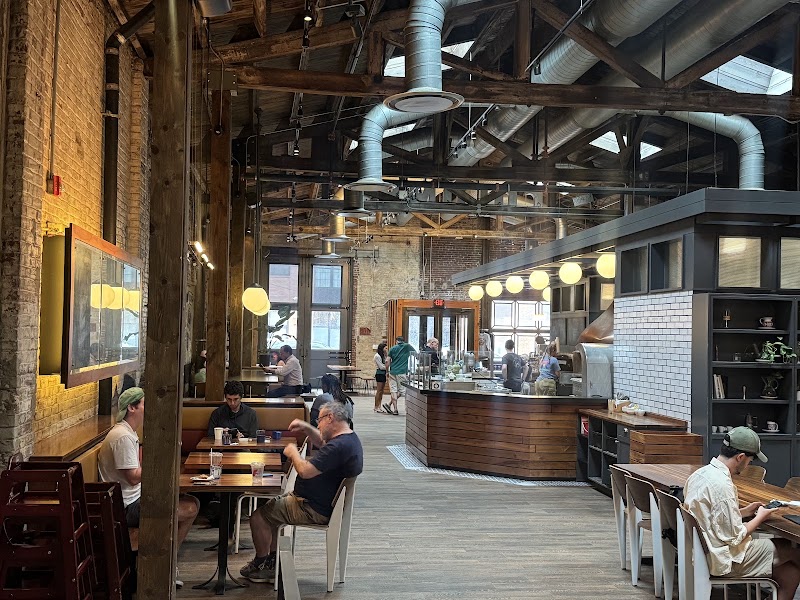
It is a converted industrial warehouse and makes no attempt to hide it: tall ceilings, skylights, exposed structure, murals on the walls, and a room that keeps going back further than you expect. Seating is deliberately varied — window tables for two, a long communal table, padded benches along the walls, a standing bar for people who are not staying, individual tables with good chairs, and a raised communal table toward the back near the glass wall of the distillery.
The result is a room that absorbs a crowd. At peak it is busy and audible, but it rarely feels cramped, because the square footage does the work that clever furniture arrangement has to do in smaller cafés. The open kitchen behind the counter adds its own soundtrack, and the roasting operation adds a smell that no candle has ever successfully imitated. It is not a quiet, hushed, minimalist specialty bar; it is a large, warm, slightly theatrical space where several trades are being practiced at once.
Beyond coffee
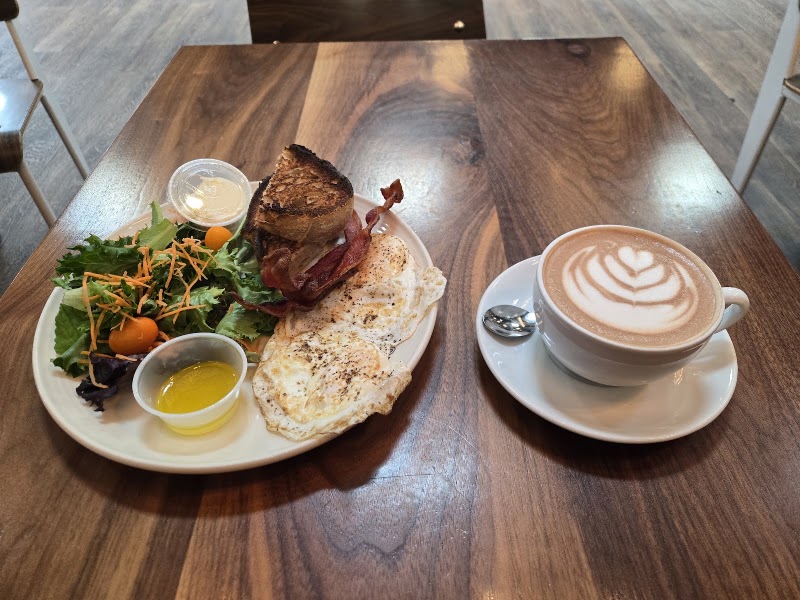
Food here is made on site rather than bought in, which is the distinction that actually matters. There is a full open kitchen, breakfast and lunch are cooked to order, sandwiches are built on bread baked in the building, and the bakery output is visible at the counter. Beer and wine are also served, which is unusual for a café and makes more sense once you know the rum still is part of the same operation.
That still, behind glass at the back, produces a coffee-infused rum — a genuinely unusual thing to find in a café, and a reflection of a company that has never been content to only do one thing. Whether you drink it or not, it explains the layout: this is a workshop in the literal sense, a building where several processes share one roof and the public is allowed to watch.
When to come
The doors open early, before the working day starts, and the first stretch of the morning is the calmest and the best-run: the counter is fresh, the bakery output is at its fullest, and the room is still quiet enough to hear the roaster. Mid-morning through lunch brings the heaviest traffic, especially at the weekend when Fishtown fills with people making a day of the neighborhood, and that is when the communal tables fill first.
Note that this is a daytime operation rather than an evening one — the kitchen and the counter wind down in the afternoon, so it is not the place for a late meeting. If you want the flagship at its most impressive, come on a weekday morning when the roastery and the kitchen are both working and the room is doing everything it was designed to do at once.
Getting there
The Workshop sits on the main commercial spine of Fishtown, in the stretch that turned this former working-class river neighborhood into one of the city’s best-known food and music districts. From Center City the simplest approach is the Market–Frankford elevated line — locals call it the El — to the Girard stop, which leaves a short and obvious walk north through the busiest part of the corridor.
Coming from Northern Liberties you can walk the whole way in a few minutes; coming from Old City it is a pleasant walk along the river side of the neighborhood. Street parking exists but is genuinely competitive in the evenings and on weekends, so the elevated line is not just the greener option, it is usually the faster one.
Good to know
Bring a plan for the internet, or bring a plan that does not need it. This is the one detail that surprises visitors most, and the staff are entirely unapologetic about it. Beyond that: the room is big, so do not judge it by the queue at the door — there is almost always seating further back than you can see from the entrance.
Be realistic about what this is. Reviewers who arrive expecting an intimate independent bar with a chatty roaster behind the counter sometimes leave disappointed, because at peak volume the service is efficient rather than lingering. The trade is a room with genuine scale, brewing methods you cannot get elsewhere, food actually made on the premises, and a piece of Philadelphia coffee history you can sit inside. If you want the quiet, single-origin, conversation-with-the-barista experience, the city has excellent smaller options — including several within a short ride of this one.
Questions and answers
Is there Wi-Fi?
No. The café does not provide an internet connection, and that is a long-standing policy rather than a technical problem. Power outlets are available, so offline laptop work is perfectly possible.
Do they roast their own coffee?
Yes. Roasting happens on site in this building, which has been the company’s home base since the flagship opened here.
Is this a good place to work with a laptop?
For offline work, yes — there are outlets, plenty of table space and no pressure to leave. For anything that needs a browser, no, unless you are willing to use your phone as a hotspot.
What makes this location different from other La Colombe cafés?
Scale and completeness. This is the flagship: roastery, bakery, open kitchen, rum distillery and company offices under one roof, with a wider brew range than the smaller cafés carry.
Is there real food or only pastry?
Real food. There is a full kitchen doing breakfast and lunch, with sandwiches built on bread baked in the building.
Can I get filter coffee rather than espresso?
Yes — bulk brew for speed, hand-poured filter for single origins, and the house Silverton method, a hybrid of immersion and filtration that you will rarely see anywhere else.
Is it suitable for a group?
Unusually so. Communal tables and a genuinely large room mean groups are accommodated rather than tolerated, which is rare in specialty cafés.
How do I get there without a car?
Take the Market–Frankford elevated line to the Girard stop and walk north into Fishtown; it is a short, direct walk through the neighborhood’s main commercial stretch.
Opening hours
| Day | Hours |
|---|---|
| Monday | 06:00–18:00 |
| Tuesday | 06:00–18:00 |
| Wednesday | 06:00–18:00 |
| Thursday | 06:00–18:00 |
| Friday | 06:00–18:00 |
| Saturday | 06:00–18:00 |
| Sunday | 06:00–18:00 |
Photos
Visitor reviews
Reviews last updated: 2026-08-10 17:37:57
Data is refreshed monthly. Sources: philadelphianka.com and editorial picks based on reviews.
Тут чудова атмосфера, і багато місця. Їжа смачна (я замовив кіш, а маленький салат, який до нього подавали, мав чудову заправку).
У приміщенні трохи галасливо, і проводити робочу зустріч було трохи важко.
Модне кафе з справді вдалим індустріальним декором у дуже жвавому районі. Сім'ї та друзі приходять сюди, щоб приємно провести час. Ефективне обслуговування, досить смачні круасани, смачна кава.
Very hip place with large sitting areas. I enjoyed the lively atmosphere with excellent taste of drinks. I know tap menus are signature but I enjoyed warm tea latte menus as well.
Родзинкою цього місця є спокійна атмосфера, в якій приємно працювати. Кава була смачною, але шкода, що їхня солона випічка не була підігрітою. Датська страва з батату була чудовою, але більше схожа на гарбузову пряність,…
Кав'ярня № 527
Майстерня La Columba
Філадельфія, Вірджинія
31 липня 2025 р.
Зазвичай я не відвідую кілька кав'ярень однієї мережі. Після того, як я отримав цей досвід, я люблю рухатися далі, якщо тільки щось справді не…