

Contralto Marian Anderson from Philadelphia was renowned not only in her hometown but across the world. In the early 20th century, African Americans had few chances for success and limited opportunities to build a singing career. Marian largely had to rely on private lessons to study singing. However, she persevered and achieved fame and success. More on philadelphianka.
Childhood and the Beginnings of Her Musical Path
Marian was born in Philadelphia on February 27, 1897. She displayed her talent for singing and music early in childhood. Although her family was poor, her father bought her a piano. She mostly taught herself, as there was no money for private lessons. Additionally, she had two younger sisters.
At age six, Marian joined the church choir, which allowed her to develop her vocal skills and earn a bit of money. When her father passed away, the local community supported her by raising funds for her musical education. However, the Philadelphia Academy of Music refused to admit an African American, so Marian continued her studies independently and through private lessons.
Her debut and first major success came when she won a New York Philharmonic competition in 1925. As the winner, Marian had the opportunity to perform with the orchestra and immediately gained acclaim. Her contralto voice captivated listeners, leaving no one indifferent.
By 1928, she was already performing at Carnegie Hall. Unfortunately, racial discrimination at the time hindered her rise and became an obstacle in her path.
Tours Abroad and Success in the United States
After encountering roadblocks at home, the young singer decided to tour Europe. She was first heard in Berlin and Vienna in 1930, and it was a triumph. When Marian performed at the Salzburg Festival in 1935, conductor Arturo Toscanini remarked that such a voice appears only once in a century. Composer Sibelius even dedicated the piece “Solitude” to Anderson.
She continued honing her vocal mastery. In Europe, she took many private lessons to make up for her lack of formal training. Additionally, she went on tour in the USSR.
In 1935, Marian traveled to Paris, where she met impresario Sol Hurok. He later managed her career and succeeded in overcoming the racial discrimination she faced in the United States. In 1939, he proposed her for a concert in Constitution Hall, but the Daughters of the American Revolution organization declined, ostensibly due to a scheduling conflict.
This decision was widely understood to be based on the fact that white and black performers had never shared a stage together, let alone in such a prominent venue. The incident sparked public outrage and scandal, leading many members, including Eleanor Roosevelt, to resign from the organization.
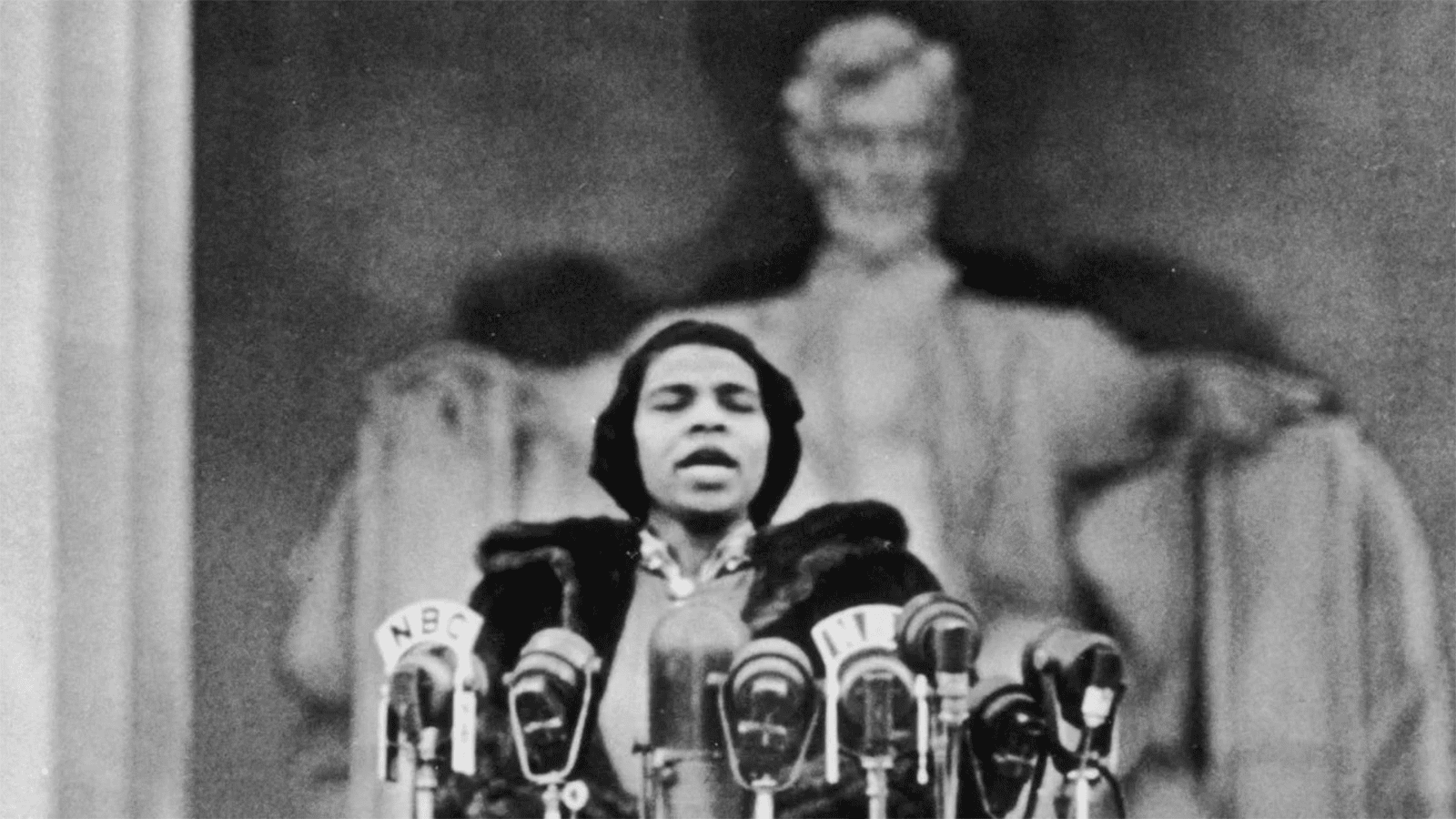
Instead, Marian was invited to hold a concert on the steps of the Lincoln Memorial. The event took place on April 9, drawing an audience of 75,000 people, with her performance broadcast on radio. It was a true sensation and an undeniable success. The Daughters of the American Revolution later revised their policies and invited Anderson to perform on their stage.
During World War II, Marian sang for soldiers, frequently visiting military bases and field hospitals. In 1955, she became the first African American allowed to sing on the New York Opera stage, performing the role of Ulrica in Verdi’s “Un Ballo in Maschera.” Although she never sang on that stage again, she was officially included in the opera company.
Her repertoire mainly included classical works, and she often performed African American spiritual music.
In 1943, Marian married architect and longtime friend Orpheus Fisher, with whom she lived for over fifty years. In 1956, she published her autobiography, which became well-known and popular.
Career End and Recognition

Marian ended her career in 1965. Recognition found her during her lifetime. In addition to her prominence in the music world, she became a United Nations goodwill ambassador in 1958 and received the Peace Prize in 1972. In 1991, she was honored with a Grammy Lifetime Achievement Award.
The singer passed away at the age of 96 due to heart failure, but her memory lives on. Marian has been honored in various ways, including:
- In 2005, she was featured on a U.S. postage stamp as part of the “Black Heritage” series.
- Her likeness appeared on the U.S. Series I savings bond in the $5,000 denomination.
- In 2011, her Philadelphia home was added to the National Register of Historic Places.
- She received a star on the Hollywood Walk of Fame, numbered 6262.
Marian Anderson’s contralto voice and exceptional talent are still remembered and appreciated by music lovers even in the 21st century. This gifted singer not only realized her potential and achieved worldwide fame but also contributed to the establishment of equality between white and black performers. Thanks to her efforts, African American performers began to receive the same respect as white artists, marking a significant achievement of the 20th century, whose effects continue to be felt in the 21st century.